New website under development
T: +44 (0) 1294 322 800
13 Ailsa Road, Kyle Estate, Irvine KA12 8LR
Get in touch with us at info@mclaughlinconstruction.co.uk

C90 - Former King's Arms
The comprehensive redevelopment of the Category `C` listed former Kings Arms Hotel, to provide six amenity flats. The one and two bedroom accessible homes will be located in the heart of Irvine Town Centre.
Working with North Ayrshire Council and their design team, including Wellwood Leslie Architects, we are redeveloping this category C listed building to create six modern, energy-efficient amenity flats for rent.
The structure had fallen into disrepair in the years after the closure of the long-standing bar and restaurant in 2015, with the council purchasing the site in response to the lack of investment and the serious decline in the condition of the building.
The project will see the careful retention of the historic façade of the building, as it remains a landmark in its own right, with the rest of the dilapidated structure being completely redeveloped from the ground up.
The new one and two bedroom flats will become the latest homes to be created as part of the council’s ambitious housebuilding programme, which will see more than 1,600 new homes built across North Ayrshire.
To download our latest round-ups of the content below, along with some other news from our firm, click the PDF buttons below.
Spring '26
Winter '25/'26
Late Summer '25
Spring '25
Chapel Lane
We’re happy to have Chapel Lane re-opened to the public.
With site works nearing completion at the Former King’s Arms, and the original paving re-laid to its new levels, access through the lane has been restored, giving a more direct route from the High Street to the homes, businesses and clubs located off West Road.

Spring '26
As the scaffold begins coming down the newly completed crisp, white form of the new building below is revealed. With finishes well under way and connections being made to essentially plug the development into the various systems it needs to function (for water, power, comms, drainage etc.), we are nearing completion.
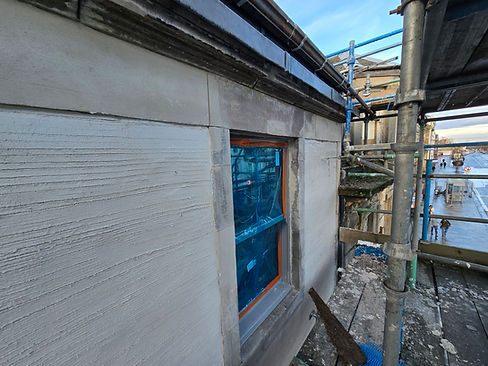
Lime render application has been completed on both the historic stone façade to the front and sides of the old hotel, and (using a slightly different product) to the new-build, rear part of the block. The rendered areas to the sides and rear of the building have also had the top coat of specialist paint applied, completing the build-up.


High Level Works Completing
Roofing works were completed by the beginning of March and the rainwater goods, including conservation type, cast iron gutters and downpipes finished in a Signal Grey, have now all been installed. External ironmongery has also been installed including the Juliet balconies on the rear of building.
The completion of high-level works to the back and sides has enabled the removal of scaffolding in these areas, revealing the rear elevation of the building in its completed form for the first time. Dismantling of the scaffold along the lane also allows for the lifting of the remaining paving, enabling the installation of essential service runs to progress. The remaining scaffold to the front/High Street elevation is expected to be removed by the end of April.
Internal Fit-Out
Inside, the flats are coming together now, with only a few finishing touches required; taping, filling and all but a final coat of paint is completed in most of the units, with the communal stair and landings following closely. Kitchen units are installed with tilling also completed throughout.
Radiator and sanitaryware installation, along with final fix of fittings are scheduled to follow completion of internal painting, over the next couple of weeks, with commissioning and testing once services are all connected.


Up-Coming
Repairs to the historic front façade are complete with just a few areas where old paint requires to be carefully removed. The lime render on this elevation will be painted, bringing the high-level external works to their conclusion and allowing the scaffold on High Street to be removed, a hugely significant milestone and a highly visible signal that the project is nearing completion.
With the scaffolding in the Chapel Lane out of the way, installation of the services for the building can now get underway, allowing us to bring power, water and communications cabling down the lane, and to take the surface and foul drainage away to tie-in points to the rear of the building. Once these are complete and tested the paving to the lane can be re-installed, to match the required entrance levels.
Winter 25/26
Brickwork and blockwork across the development were completed in late November / early December, alongside the conclusion of the extensive stone repairs to the preserved historic façades. This work marks an important moment in the project; though still masked by the scaffold needed to provide safe access, the building’s external form is now fully established and the original character of the King’s Arms carefully restored.


Roof Works
Roofing works are also nearing completion. The natural slate roof is now entirely finished, with the final section to the rear of the original building concluded in early February. Leadwork and rainwater goods are largely complete and are already making a significant visual difference, tying the restored elevations and new-build elements together and giving a clear sense of the quality of the finished building.
Traditional Lime
Lime render application is well underway, using two slightly different systems for the historic and new sections of the building, while maintaining a consistent overall appearance. Both areas are being finished with breathable lime render, applied in successive coats to build up strength and durability. The final render coat is then passed over with a hand-held machine to create a subtle textured finish.
Once fully cured, all elevations will receive a lime-render-compatible painted top-coat in a uniform white colour, ensuring a robust finish and cohesive appearance across old and new fabric alike.

Sustainable Heating
Inside the building, the transformation is now very apparent. Internal partitions are in place and doors have been installed throughout, meaning the individual flats are clearly defined and beginning to feel like real homes.
The installation of the Joule Green Comfort/Modulair heating system marks another milestone, introducing very modern but complementary technology alongside the historic fabric. Based on an exhaust air source heat pump, the system captures heat from air extracted from within the building and reuses it to provide space heating and domestic hot water.
In addition to heating, the system incorporates mechanical ventilation with heat recovery (MVHR), continuously supplying fresh, filtered air to the flats while recovering heat that would otherwise be lost. An optional pre-heating function warms incoming air before it enters the living spaces, improving comfort and reducing overall energy demand.
By using low-carbon electricity and re-using heat already generated within the building, the Joule system is expected to significantly reduce energy consumption and carbon emissions compared to traditional gas-fired systems. This approach supports the council’s sustainability ambitions, is designed to reduce running costs for residents, and helps future-proof the development against increasingly stringent environmental standards.
Late Summer '25
Installation of the roof trusses was completed in early summer and the roof has been sheeted and covered with its waterproof membrane. Leadwork was started and the natural slate that will complete the build-up is all on-site ready to go, once the brickwork is done.
Windows are now installed throughout – type dependent on location within building: those within the preserved stonework elevations to the front (Main St.) and side (Chapel Ln.) of the building, are traditional sash and case timber windows, made by a well-respected Scottish manufacturer, and compliant with Listed Building Consent requirements.
The new-build portion benefits from high performance, Scandinavian fenestration - again, manufactured with a timber frame, but then over-clad with an aluminium layer for extended durability and to minimise future maintenance requirements.


Restoring & Preserving
The old, non-traditional render has been painstakingly removed from the stonework with extensive surveys following, undertaken to study the condition of the stone below and confirm the final scope of the job to preserve and restore what is there.
Meticulously detailed schedules have been produced by the council’s architects, setting out exactly what repairs need to be made and where. This work, being undertaken by our specialist sub-contractor, can range from carefully filling where material has been lost, to the complete removal and replacement of very badly damaged/eroded stones.
New Build & Ecology
The brick and blockwork making up the outer skin of the newbuild portion of the project are very close to completion, concluding at end August.
This includes the installation of a “sparrow terrace”, a “swift block” and some bat-boxes, specified in the design for this refurbishment and underlining the council’s commitment to conservation


Progress Inside
Inside the building, the floors have been laid and the first-fix of ceilings and external walls has been completed – basically meaning the upper/outer layers of the ceilings and walls have been installed.
The services (plumbing and wiring) can now be fitted into what will be a service void, before the finished surfaces are applied over those.
Partitions are going up inside the flats and the mechanical and electrical installations are getting under way too, with a sprinkler system almost completed already.
Spring '25
Once the SFS walls are in place the windows can be installed – likely to be around late April into May.
The roof works include lots of leadwork and other details, and a large portion of the external brickwork needs to be complete before the slates will finally go on.
Once the scope is agreed the job of carefully repairing the old stonework and chimneys will also be undertaken.
Thereafter it’s on to the insides and getting ready for the finishes.
Image: Provost Anthea Dickson at the King’s Arms site with Irvine West Councillors Shaun Macaulay, Scott Gallacher and Chloe Robertson; Council officials and staff and representatives from McLaughlin Construction.


Chapel Lane
The ground levels in Chapel Lane, leading from High Street through to West Road, are being reconfigured as part of the project.
The carved stone paving has been carefully lifted and is being safely stored.
Coupled with the requirement to install a scaffold and the lack of space at that side of the building, this means the lane is closed and is likely to remain so until the project completes.
We appreciate this causes issues with access to the buildings, clubs etc. on West Road – unfortunately, there is no alternative, but it will be reopened as soon as possible.
Autumn/
Winter '24/25
With the steel frame in place the team on-site are busy preparing to complete the skin around it.
Work on the roof is well underway and once the final roof trusses have been manoeuvred into place, the sheeted surface will be added, followed by the roofing membrane, essentially making it watertight.
Construction of the walls is about to get underway and once the SFS (Steel Framing System - a quick, strong method of building walls) is in place, the external brick skin can be constructed.
We have also started removing the old render from the historic walls, after which they will be surveyed again to establish the final scope of stonework repairs. This may be a little noisy from time to time but our teams are working only during sociable hours.
Image: Steel frame nearing completion with temporary trusses showing/amongst


Summer '24
SITE START TO STEEL FRAME
This update covers what has happened on-site since the beginning of our involvement in the project, back in the summer of 2024.
Temporary works – as soon as we took possession of the site and got into dismantling the building, it became clear it was in even worse condition than initial investigations had revealed. The requirements of the temporary propping works (scaffolding, temporary metal trusses/beams and massive chunks of concrete) were far greater than anticipated, and the retention had to be redesigned.
Once that was safely in place we carefully removed the old fabric, with demolition completing in the middle of August ‘24, leaving behind only the important façades, held securely in place by our temporary structures.
Preparations continued with groundworks, including foundations and drainage, being undertaken, followed later in the autumn by the erection of the structural steel frame.
Going up very quickly (38 tons of steel, in only just over a week – concluded by end October) the ‘skeleton’ of the project rapidly started to appear, giving the first real representation of the form and scale of the finished building and possibly the only, momentary glimpse of its structural form.
Image: Temporary supports securing the historic facade